Logo Unveiled: Canada Research Chair in Translation and Colonialism
October 2026
For the design of this original logo for the Canada Research Chair in Translation and Colonialism, we reached out to Mi’kmaw artist Melcolm Beaulieu, of the Metepenagiag Mi’kmaq Nation. The logo draws inspiration from fiddleheads, a symbol closely connected to the land on which the Université de Moncton is located. It represents two entities that meet, unite and transform, while remaining distinct and sovereign in their own right: a nod to translation. Melcolm Beaulieu also produced a beaded version of the logo. For the digital version, the artist worked in collaboration with graphic designer Luckensy Odigé.

Program Launch: Fall 2026 Edition of the Anticolonial Book Club
September 2026
The Cercle de lecture anticolonial (CLAC) is back at Université de Moncton (Moncton Campus)! Spearheaded by the Canada Research Chair in Translation and Colonialism, this reading circle provides a space where learners, instructors, university staff, and like-minded individuals can gather to discuss the complexities and ongoing impacts of colonialism. Once a month, participants meet to discuss previously selected readings on the topic of colonialism in Canada and elsewhere, highlighting its various forms throughout history and the resistance movements that arise in response.
Publication of French translation full-métal autochtoqueer
June 2026
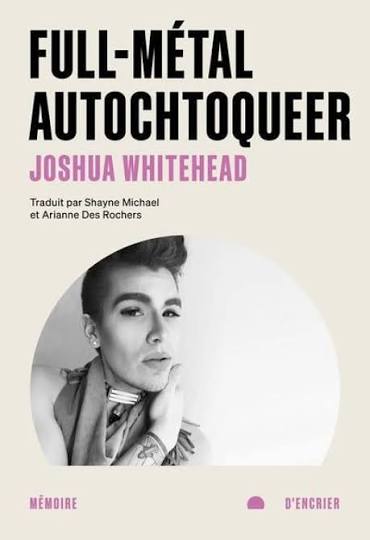
Originally published in 2017, the first ever poetry collection by Oji-Nêhiyaw writer Joshua Whitehead full-metal indigiqueer (Arsenal Pulp Press) is now available in French! The collection, a collaborative translation between Shayne Michael and Arianne Des Rochers, was published in June of 2026 by Mémoire d’encrier.
Joshua Whitehead’s debut collection revolves around a hybridized being known as zoa. This enigmatic figure straddles the line between the cybernetic and the Two-Spirit, reemerging in the wake of an apocalypse. As a virus, zoa infects canonical and popular works by the likes of Spenser, Shakespeare, Dickens, and Milton, as well as more contemporary cultural touchstones like Lana Del Rey, Grindr and Peter Pan. They create a fourth dimension, where Two-Spirit existence thrives in NDN time. The futuristic narrative full-metal indigiqueer (French translation: full-métal autochtoqueer) explores the enduring nature of queer Indigenous experiences, despite the impact of colonial violence. It offers a vision of a future that is at once utopian and deeply grounded in Indigenous traditions.